


When you search for tree cabling vs. tree removal, you get answers that all sound confident, and none of them agree. One site tells you to cut the tree down before it falls. Another insists cabling can save it. If you are looking at a leaning oak or a split maple in Allison Park, you need a clear answer, not more noise.
Arborist tree cabling involves installing steel or synthetic support systems in a tree to reinforce weak branch unions, co-dominant trunks, or storm-stressed limbs so the tree keeps standing instead of coming down. Tree removal takes the whole tree out once saving it is no longer safe or realistic.
This article compares both options side by side, so you know which one fits your tree before you commit.
Tree cabling works best for structurally valuable trees showing early warning signs, while tree removal may be necessary once a tree is dead, diseased, or too hazardous to keep standing.
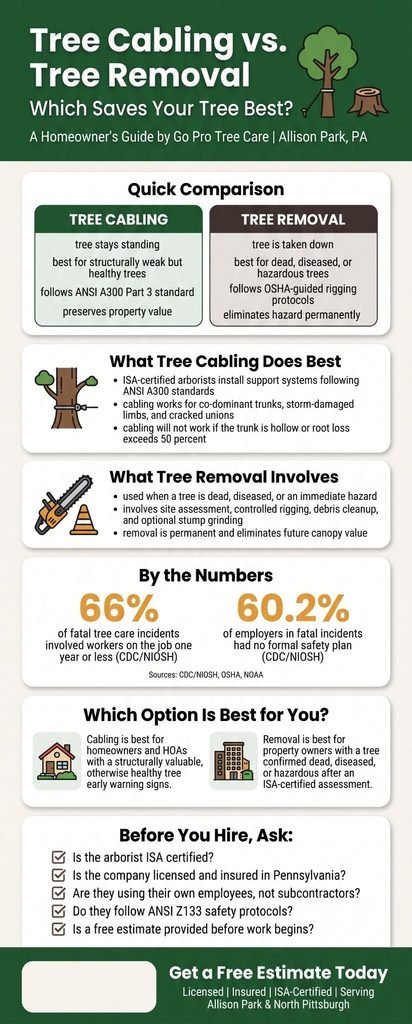
‘Quick Comparison: Tree Cabling vs. Tree Removal
A tree cabling assessment by an arborist starts with comparing both real options side by side so you can make an informed decision.
| Factor | Tree Cabling | Tree Removal |
| Tree outcome | The tree stays standing. | The tree is taken down. |
| Best for | Structurally weak but healthy trees | Dead, diseased, or severely hazardous trees |
| Governing standard | ANSI A300 Part 3 support systems | OSHA-guided rigging and felling protocols |
| Typical decision driver | Early cracks, leaning, or co-dominant trunks | Confirmed decay, disease, or storm failure |
| Long-term result | Preserves mature tree and property value | Eliminates the hazard permanently |
- How to Read This Comparison Table
Match your tree’s condition to the middle column. If damage is severe, go straight to the removal column.
What Tree Cabling Does Best
Professional tree cabling protects a structurally valuable tree by adding physical support exactly where it is weakest, so the tree keeps growing instead of being cut down. The cable or brace redirects stress away from a cracked union, buying the tree years of additional safe life.
- How ISA-Certified Arborists Install a Support System
ISA-certified arborists follow ANSI A300 (Part 3) Supplemental Support Systems, the national standard for cabling, bracing, and guying. OSHA guidance on tree care work also recommends a qualified arborist survey the worksite before any support or rigging work begins.
An arborist inspects the branch union up close, checking for included bark, cracks, or decay pockets before choosing a static or dynamic cable system, then installs hardware above the weak point to redirect load away from the failure zone. This fits within Go Pro Tree Care’s pruning and tree health assessment services.
- Why the Cabling-First Decision Is Rarely Explained Locally
Some tree service information focuses heavily on removal and gives less attention to when a support system may be appropriate. Understanding both options helps property owners make a more informed decision.
Pennsylvania’s DCNR Urban and Community Forestry Program encourages inspecting tree hazards before removal, not after. Go Pro Tree Care follows that same order: a tree health assessment first, a removal quote only if the tree cannot be saved.
- Signs a Tree Is a Good Candidate for Cabling
A tree is usually a strong candidate when it has a co-dominant trunk with a narrow, V-shaped union, a long horizontal limb over a driveway or roof, or storm cracking without full structural failure. Mature, healthy trees with landscaping value are good candidates too.
If the trunk has extensive decay or the root system is severely compromised, cabling will not fix the underlying problem.
What Tree Removal Involves
Before recommending removal, Go Pro Tree Care first conducts a tree cabling and support assessment to confirm the tree truly cannot be saved.
- What the Removal Process Looks Like
Go Pro Tree Care removes trees using rigging techniques that lower cut sections in a controlled sequence, protecting structures below.
OSHA’s inspection guidance for tree care operations lists falls and power-line contact as leading risks, which is why removal is handled only by trained, in-house crews. The process includes a site assessment, written estimate, dismantling, debris cleanup, and stump grinding on request.
- When Removal Is the Only Safe Option
Removal is necessary when a tree is dead, severely diseased, structurally compromised, or an immediate hazard.
Allegheny County records dozens of severe wind and storm events every year, according to the NOAA Storm Events Database, which is why storm-weakened trees are a recurring local removal trigger. Removal is permanent: once a tree is down, its shade and property value contribution are gone.
The Key Differences That Matter
Weighing arborist tree cabling against removal comes down to two trade-offs that matter most before you decide.
- Removal Solves the Immediate Hazard, But It Is Permanent and Does Not Fit Every Tree
Yes, removal eliminates a hazardous tree completely and immediately. But it also removes future canopy and curb appeal, and it does not distinguish between a tree that could have been saved and one that could not. A tree health assessment before removal confirms whether cabling is realistically an option first.
- Cabling Preserves Structurally Valuable Trees, But Only When Installed to ANSI A300 Standards
Yes, cabling can keep a structurally weak tree standing for years. But that depends entirely on correct installation.
A CDC and NIOSH study on fatal tree care injuries analyzing 93 investigations found that over 66% of fatal incidents involved workers on the job one year or less, and 60.2% of employers had no formal safety plan.
That is why cabling should only be installed by a licensed, ISA-certified arborist following ANSI A300 protocols, not attempted as a DIY fix.
Which Option Is Best for You?
Choosing between arborist tree cabling and removal gets easier once you know which profile matches your tree and your priorities.
- Best For: Tree Cabling
Homeowners, landlords, and HOAs in Allison Park or North Pittsburgh with a structurally valuable, otherwise healthy tree showing early warning signs like a co-dominant trunk or a single storm-damaged limb.
- Best For: Tree Removal
Property owners and commercial managers with a tree that is dead, diseased, hollow, or confirmed hazardous after an ISA-certified assessment, where saving the tree is no longer safe.
- Questions to Ask Before You Hire Anyone
Confirm the arborist is ISA certified and ask to see the certification number. Confirm the company is licensed and insured in Pennsylvania, and request a certificate of insurance before work begins.
Ask whether the crew is the company’s own employees or subcontractors, since subcontracting can shift accountability. Confirm the crew follows ANSI Z133 safety protocols for rigging or removal, and confirm a free estimate before agreeing to a plan.
Frequently Asked Questions
These are the arborist tree cabling and removal questions Go Pro Tree Care hears most often from homeowners and property managers in the Allison Park area.
- Can a damaged tree really be saved with cabling instead of removal?
Yes, in many cases. Tree cabling can save a structurally weak tree by adding support at the weak union, following the ANSI A300 Part 3 standard. This works best on early-stage issues, not severe decay or root loss, where removal is safer.
- How do I know if my tree needs cabling or removal?
An ISA-certified arborist evaluates the trunk, root system, and branch unions during a tree health assessment. Early cracking or a single weak limb may make a tree, a candidate for cabling, while hollow trunks or extensive decay may require removal.
- Is it safe to install tree cables myself?
No. OSHA’s Tree Care Industry safety page lists falls, struck-by injuries, and electrocution as leading hazards in this work. Cabling can require aerial access and load calculations, so it should be handled by a qualified, insured arborist.
- How much does tree cabling cost compared to tree removal in Allison Park?
Costs vary based on tree size, support points needed, and site access. Go Pro Tree Care provides a free estimate after an on-site assessment for either service.
- How long does a cable or brace system last once installed?
A properly installed system typically lasts many years, but it needs periodic inspection, since ANSI A300 standards call for regular checks to confirm the hardware and tree growth remain compatible.
The Final Step
Choosing between tree cabling and tree removal comes down to one thing: whether your tree’s structure can still be saved. A tree health assessment from an ISA-certified arborist gives you a clear answer instead of a guess.
Go Pro Tree Care’s licensed, in-house arborists serve Allison Park and North Pittsburgh with no subcontractors on any job. Get a free estimate today, and find out whether cabling can save your tree or removal is truly the safer path forward.